In this final lesson experience of The Modern Pioneer Cookbook Curriculum, we explore Chapter 14 and the comforting world of “Traditional Comfort Food Meals.” These recipes show how simple ingredients can come together to create nourishing dinners that bring everyone to the table. Along the way, students of different ages learn valuable kitchen skills, explore the history and nutrition behind traditional foods, and reflect on the lessons they’ve gathered throughout the curriculum. (This lesson experience includes three free activity downloads, plus checklists and certificates!)
Affiliates note: As an Amazon Associate I earn from qualifying purchases. My content may contain affiliate links to products and services. If you click through and make a purchase, I’ll receive a small commission. It does not affect the price you pay.
Table of Contents
- About The Modern Pioneer Cookbook Curriculum Lesson Experience Series
- Getting Started with Traditional Comfort Food Meals
- Grandma Joins Us!
- 5-8 Activity: Benefits of Salmon
- K-4 Activity: Dredging
- 9-12 Activity: Chili Timeline
- Recipe: Salmon Dinner
- Tasting the Recipe
- Discussion: Reflection
- Celebrating Achievements
- Final Thoughts
- The Modern Pioneer Cookbook
About The Modern Pioneer Cookbook Curriculum Lesson Experience Series
Hi! My name is Jamie O’Hara, and I’m a homeschooling mom, curriculum writer, and former classroom teacher. I recently had the pleasure of helping Mary Bryant Shrader create The Modern Pioneer Cookbook Curriculum, which includes extensive lesson plans for grades K-12 to complement Mary’s bestselling book, The Modern Pioneer Cookbook.
- Get The Modern Pioneer Cookbook Curriculum (Free and over 250 pages!)
- Get The Modern Pioneer Cookbook
- Read The Modern Pioneer Cookbook Curriculum Lesson Experience Article Series
Now, I’m excited to embark on a journey of experiencing these lessons with my own children, ages 6 and 8 (and sometimes my 3-year-old, too). I’ll be facilitating a total of 14 lessons, one for each chapter in The Modern Pioneer Cookbook Curriculum. As we go through the curriculum, I’ll document our experience to share with all of you!
Getting Started with Traditional Comfort Food Meals
Chapter 14 is the final chapter of The Modern Pioneer Cookbook, and its focus on home-cooked comfort food meals is the perfect way to wrap up this curriculum. The chapter provides recipes for six delicious dinners that can serve as basic templates for you to customize according to your family’s preferences and the ingredients you have on hand. The table below summarizes the recipes, principles, and learning objectives for each lesson.
| Grade Band | Recipe | Traditional Kitchen Principles | Learning Goals (Students will…) |
| K-4 | Panfried Breaded Whitefish with Homemade Tartar Sauce | 1. Homemade food 2. Low-waste kitchens | ● Describe the culinary techniques of dredging and breading ● Prepare breaded whitefish, following a recipe ● Summarize what they have learned about making homemade traditional foods and minimizing waste |
| 5-8 | Sheet Pan Baked Salmon with Maple Sugar Glaze and Roasted Vegetables | 3. Real, whole foods 4. Seasonal eating | ● List health benefits of salmon ● Prepare a baked salmon and vegetable dish, following a recipe ● Summarize what they have learned about eating seasonally and cooking with real, whole foods |
| 9-12 | Budget-Friendly Southwestern Chili con Carne | 5. Maximizing nutritional value 6. Preservation for self-sufficiency | ● Describe the origins of chili ● Prepare chili con carne, following a recipe ● Summarize what they have learned about maximizing food’s nutritional value and preserving food for self-sufficiency |
Overview of Each Grade Band’s Recipes
For the K-4 lesson, you will need skinless sole fillets, flour, eggs, breadcrumbs, herbs, butter, lemon, mayonnaise, and bread and butter pickles. This recipe is even more special if you make your own mayonnaise from scratch! (You can find the recipe for Olive Oil & Egg Mayonnaise on page 184 of The Modern Pioneer Cookbook.)
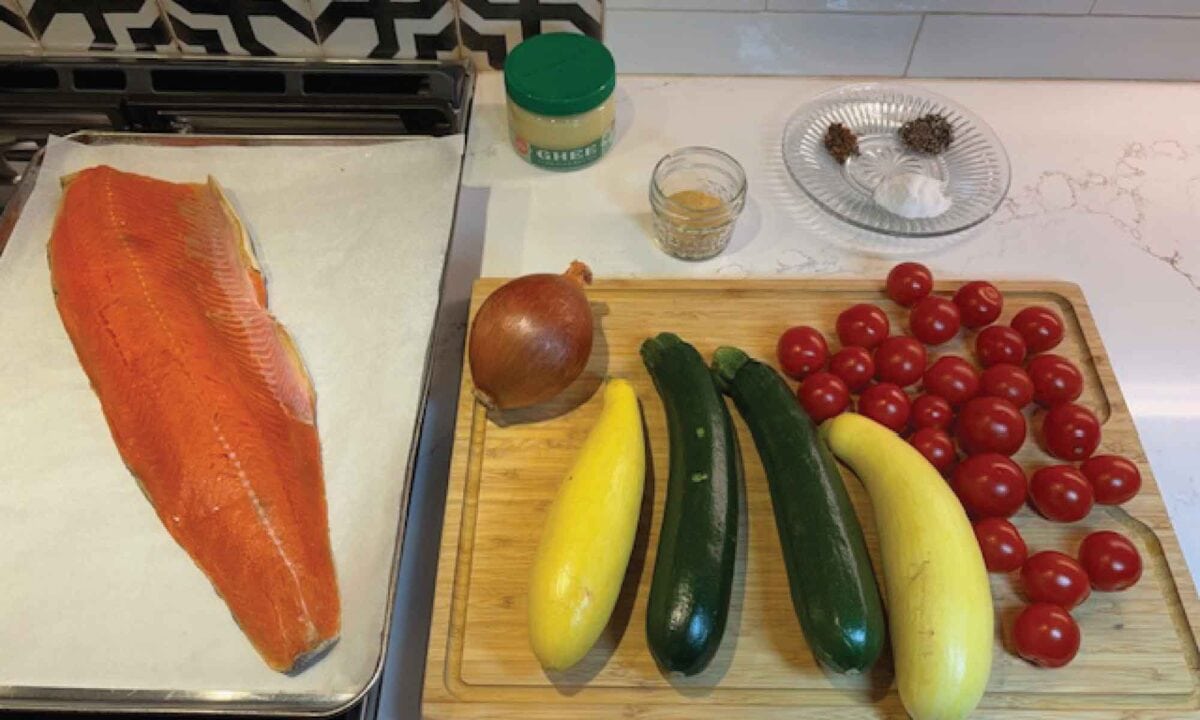
For the 5-8 lesson, you will need a large fillet of wild-caught sockeye salmon, maple sugar, ghee, onion, cherry tomatoes, zucchini, yellow summer squash, and some seasonings.
For the 9-12 lesson, you will need chuck roast, beef liver, lard, masa harina (nixtamalized corn flour), dried chiles, onion, garlic, beef bone broth, flour, diced tomatoes, and seasonings.
Both lessons that prepare fish dishes take about 30 minutes, while the total time required for the chili con carne can be up to three hours. If you’re looking for the easiest meal, it’s the 5-8 recipe for baked salmon. No dredging or pan-frying; put everything on a sheet pan and just pop it in the oven!
Planning for Students of Different Ages
For most of the lessons in The Modern Pioneer Cookbook Curriculum, the discussion comes first, followed by an activity and then the recipe. For these final lessons, the activity comes first, followed by the recipe. The discussion comes last, giving families the opportunity to reflect not only on what they did for Chapter 14, but also on what they learned and accomplished throughout the whole curriculum experience.
In this sense, the discussion guide for each grade band is very similar, except that each grade band will focus on the two traditional kitchen principles that informed their curriculum track (see table above). If you have students in different grade bands, it makes sense to combine their discussions into one, having each student reflect on the themes specific to their lessons.
Working Together on the Recipes
Students of different ages can work together on any or all of the Chapter 14 recipes.
The K-4 activity on the dredging process will likely be too simple for most high schoolers and middle schoolers, but they could facilitate the activity for their younger siblings, if applicable.
The 5-8 activity on the benefits of salmon is appropriate for students of all ages; younger students can draw or write simple words and phrases, while older students can provide more detail on their projects.
The 9-12 activity involves some Internet reading and the creation of a timeline focused on the history of chili; this activity is appropriate for middle schoolers, but probably not for most elementary students.
As always, it’s an excellent idea to preview each lesson beforehand in order to plan for each unique student.
Grandma Joins Us!
For our final Modern Pioneer Cookbook Curriculum lesson experience, my mom joined us in the kitchen! As an owner of The Modern Pioneer Cookbook, she was ready to make the baked salmon. But she didn’t know that I was going to have her take the lead in facilitating the activity and discussion, too!
Having facilitated thirteen of these lessons so far, I wanted to see how well someone else could follow my lesson plans, especially with no prep! Fortunately, my mom was a good sport and jumped right in. For the record, she was never a teacher and has no homeschooling experience, but she did great! (If you are inexperienced or lack confidence when it comes to homeschooling, take a leap of faith and jump right in. You may be surprised at how well it goes!)
Grandma joining us for this lesson also had the unexpected benefit of helping us review our past lesson experiences. My children got her situated by first showing her their kitchen journals and all the notes they’d taken as they learned about homemade food and low-waste kitchens. This helpful extra step warmed us up for our final lesson.

5-8 Activity: Benefits of Salmon
Although my children are elementary-aged, we decided to make the salmon recipe from the 5-8 lesson. I thought it would make more sense to follow the 5-8 activity as well, rather than the dredging activity that precedes the K-4 recipe.
My mom began by asking her grandkids about their experiences eating salmon and how they like it prepared. Then she helped them identify some of the health benefits of salmon, prompting and hinting as needed.
They made three lists:
- One showing the parts of our body that benefit from eating salmon,
- One showing the healthy nutrients that salmon contains, and
- One showing the illnesses and conditions that salmon can help prevent.
The 5-8 lesson plan suggests discussing these points first, and then giving students time to create an infographic or video presenting the information in an engaging way. However, we simplified the process a bit and had my children write and draw as we discussed. Depending on your students’ level of interest and your schedule constraints, the time spent on this activity can vary greatly.
My son made his lists and drawings in his kitchen journal, while my daughter used the printable worksheet I made for this activity.
- Download the Salmon Worksheet (5-8) (PDF file)
Interdisciplinary Extensions
During our discussion, we briefly touched on a few of the interdisciplinary extensions included at the end of the lesson plan. Specifically, we talked about the difference between wild-caught and farmed salmon, as well as the significance of salmon in different cultures.
For example, we looked at some indigenous salmon art from Pacific Northwest tribes and recalled the role of salmon in Irish myths, such as the story of Fionn mac Cumhaill (Finn MacCool).
K-4 Activity: Dredging
The elementary activity for Chapter 14 has students acting out the process of dredging and breading food.
First, they learn the following vocabulary:
● Dredge: to coat wet or moist food with a dry ingredient (like flour) before cooking
● Breaded: dredged, coated in eggs or another liquid, and then dredged again
Then, using paper cutouts of fish, egg, flour, and breadcrumbs, they act out each step of the process. Some students will prefer to draw their own ingredients and cut them out. However, to offer more options and support students who don’t like drawing, I created a printable worksheet you can download. It contains images of the ingredients, which can also be colored if desired.
- Download the Dredging Activity (K-4) (PDF file)
My youngest child, who only sometimes participates in our Modern Pioneer Cookbook Curriculum lesson experiences, worked on this activity while his older siblings were learning and writing about salmon with Grandma. I gave him three plates and helped him nail down the proper sequence and technique. When his paper fish was “breaded,” we pretended to fry it in a small pan on the stove in our play kitchen.
To make this activity a little more advanced for older elementary students, invite them to conduct a teaching demonstration where they explain how to dredge and bread fish. Optionally, film them and share their video with grandparents or friends!
9-12 Activity: Chili Timeline
The high school lesson activity teaches students about the history of a southwest staple: chili.
Students are tasked with reading about the history of chili as presented by an organization called the Chili Appreciation Society International. They will learn about the San Antonio Chili Queens, the role of chili in nineteenth-century Texas prisons, and the spread of chili from the Southwest to the Midwest for the 1893 Chicago World’s Fair.
Students may also be interested in entering the lively discourse about whether “true” chili contains beans! According to Texans, the answer is a resounding, “No!” But of course, everyone has their own opinions about this.
After learning about the exciting history of chili, high schoolers will record the most important or interesting events on a timeline. You can download a printable worksheet for this activity. Alternatively, this activity can become more writing-intensive by having students draft a blog post titled “10 Interesting Facts About Chili.”
Recipe: Salmon Dinner
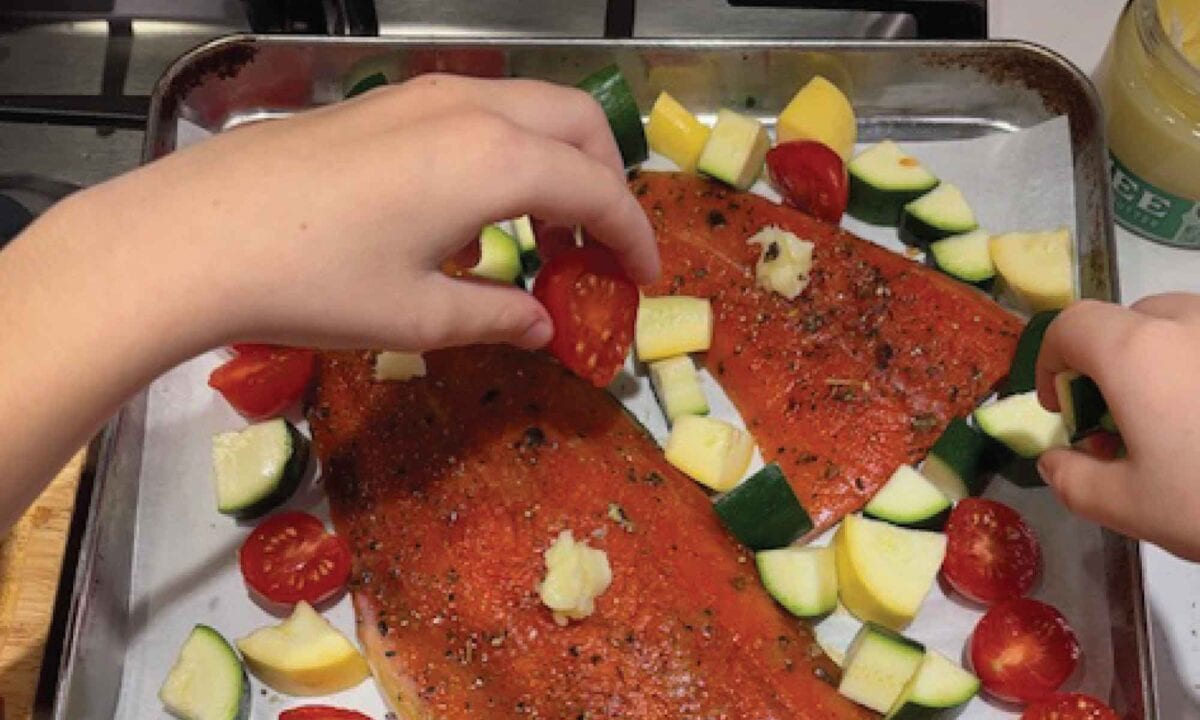
To get started with our salmon dinner, we gathered our ingredients and supplies. First we washed and chopped the vegetables and measured out our seasonings. We lined a baking sheet with parchment paper and placed the salmon fillet on top.
Next, we seasoned it, sprinkled maple sugar, dropped a few dollops of ghee on top, and then arranged the vegetables around it. Finally, we added some ghee and salt and pepper to the veggies before putting the sheet pan into the cold oven.
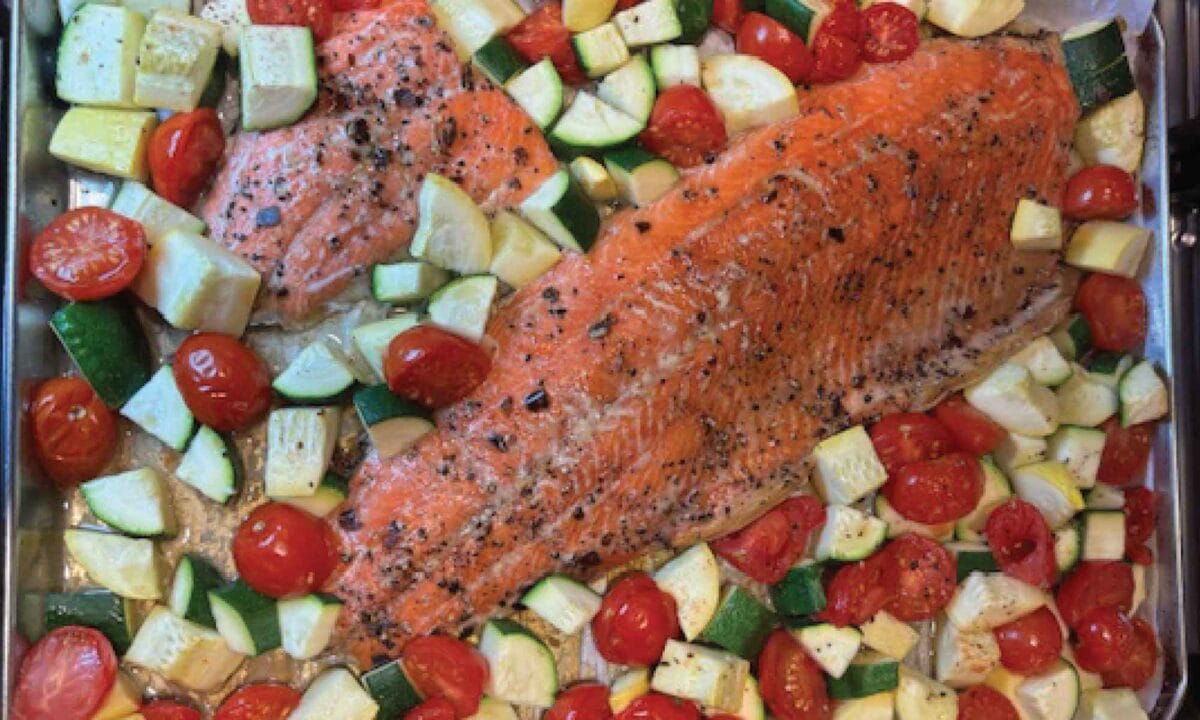
We set the temperature to 400°F (204°C), and 20- 25 minutes later, the meal was done! Overall, the most time-consuming part was chopping the vegetables. I’d say this is an excellent recipe for a busy weeknight meal.
Tasting the Recipe
The baked salmon was delicious! We ate it for dinner, and everyone loved it—with the exception of my middle son, who is generally wary of seafood (he did try it, though!). But my daughter and my younger son both gobbled it up!
The hearty squash, tomato, and onion mixture makes this recipe able to stand alone as a true sheet pan dinner with minimal cleanup. But we bulked it up with some rice, and it would also pair well with pasta or potatoes.
Making The Meals Your Own
In the introduction to Chapter 14, Mary shares her encouragement to experiment with these comfort meal recipes and make them your own. In her words:
“Once you find that you can prepare these meals with ease, you can begin to put your own spin on them by varying the vegetables or the herbs and spices that you use. As you become comfortable with customizing the recipes, keep in mind that each of these recipes has its roots in a different traditional culture. And that’s good news because although different, most traditional cultures have a lot in common. For example, once you master how to make a sauerbraten, switching up the ingredients to make an American-style pot roast, an Italian stracotto, or a Mexican carne guisada is easy.”
We customized the baked salmon recipe only a tiny bit. Our family loves New Mexican Hatch chile, and I almost always used crushed dried chiles as a substitute for crushed red pepper. If your students have their own favorite seasonings, allow them to experiment with different combinations on their salmon and veggies, encouraging them to take notes in their kitchen journals about what tasted best.
Discussion: Reflection
We decided to have our discussion while the salmon baked in the oven, and this is also a great idea for those preparing the chili con carne, which needs to cook for about two hours. My mom started the discussion by asking my children to share which recipes they prepared over the course of the curriculum.
To make it easy to keep track—and to encourage your family to prepare additional recipes in the future—I created a printable checklist that you can download.
My kids proudly checked off each recipe they followed, sharing their opinions about what was most delicious, what was easiest, and what was most difficult to prepare. Grandma asked them to summarize the meaning of homemade food and low-waste kitchens before praising them for developing critical skills that will serve them well into adulthood.
We also made some plans to make certain things again and try recipes we didn’t have a chance to prepare yet. We also discussed our excitement for the next installment of The Modern Pioneer Curriculum series—but we won’t spoil that surprise just yet!
Celebrating Achievements
If you have worked through all fourteen lessons with your students, give yourselves a hand!
To celebrate your students’ achievements, consider presenting them with a certificate of completion. I created two variations that you can download, or you can make your own!
- Download the Modern Pioneer Cookbook Curriculum Certificate of Achievement – Traditional Border (PDF file)
- Download the Modern Pioneer Cookbook Curriculum Certificate of Achievement – Fruit Border (PDF file)
Final Thoughts
I feel so blessed to have had the opportunity to work on The Modern Pioneer Cookbook Curriculum and facilitate fourteen lesson experiences with my children! We have all gained valuable skills and more deeply internalized the important values of a traditional foods kitchen.
I hope that sharing our experiences has helped inspire you to bring these skills and values into your own home.
Charlotte Mason and the Homeschooling Community
One thing I love about how Mary wraps up this cookbook is her tribute to Charlotte Mason, who has been a consistent influence on the homeschooling community since the late nineteenth century. Charlotte Mason advocated for what she called “living books,” or books that are rich with complex and engaging ideas, written by people whose passion for their subject shines through their words.
The Modern Pioneer Cookbook is one of these books, as its author truly lives her passion for traditional foods and home cooking, and its recipes are nestled among personal narratives and anecdotes that illustrate the importance of food and cooking in a relatable way.
Whether or not you’re a homeschooling family, this cookbook should be a treasured “living book” with a permanent home in your kitchen so you can refer to it time and again, year after year.
Share Your Experiences
If you don’t already have a copy of The Modern Pioneer Cookbook, I highly suggest purchasing one so that you can follow along with the free curriculum and our lesson experiences. And if you complete any of these lesson activities or recipes, be sure to tag @MarysNest on social media to share your experiences. The greater community of Modern Pioneers would love to learn along with you!
Order YOUR COPY Now!
The Modern Pioneer Cookbook
Seasonal ingredients, traditional techniques, and nourishing recipes. Over 85 traditional, from-scratch recipes! Discover for yourself how you can use simple ingredients and traditional techniques to cook the modern pioneer way.