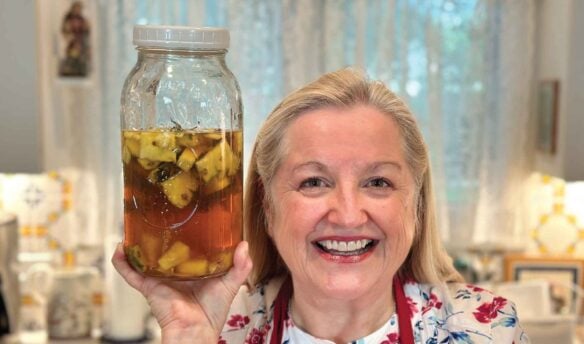
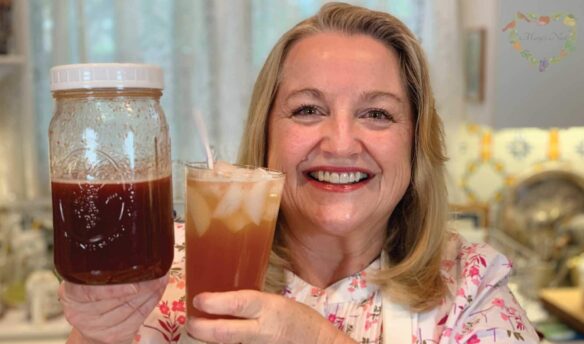
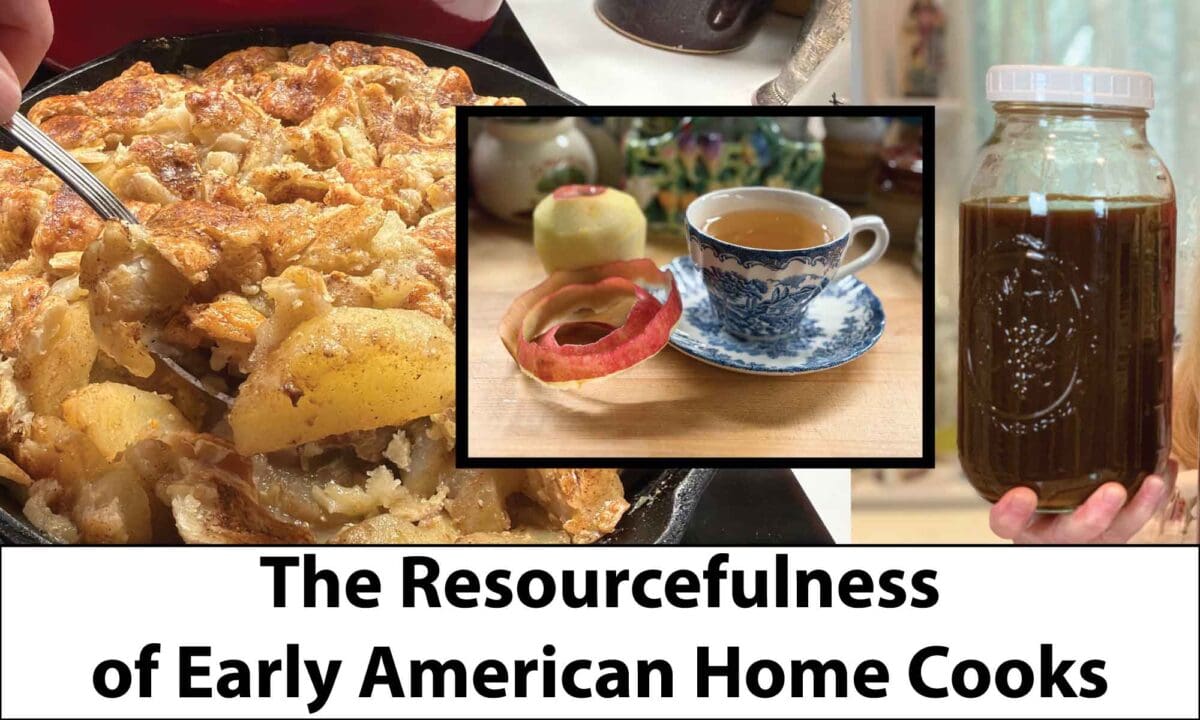
Today, I am sharing three traditional recipes you can make to celebrate the thriftiness, creativity, and resourcefulness of early American home cooks: Old-Fashioned Apple Peel Tea, Apple Pandowdy, and Switchel.
Affiliates note: As an Amazon Associate I earn from qualifying purchases. My content may contain affiliate links to products and services. If you click through and make a purchase, I’ll receive a small commission. It does not affect the price you pay.
Table of Contents
- The Resourcefulness of American Home Cooks
- The Waste-Not Wisdom of Early American Kitchens
- What Is Apple Peel Tea?
- Use Fresh or Dried Apple Peels
- Make Apple Pandowdy and Save the Peels
- Abigail Adams and the White House Table
- Cool Off with Traditional American Switchel
- Three Recipes Built on Thrift and Simplicity
- Keeping American Food Traditions Alive
- Celebrating America’s 250th Anniversary
- More Independence Day Posts and Recipes
- Grand Teton Ancient Grains
- Grind Your Own Flour with the Mockmill
- The Modern Pioneer Cookbook
- The Modern Pioneer Pantry
- Start Your Traditional Foods Journey
- Download Your Free 36-Page Pantry List
- Join the Traditional Foods Kitchen Academy
- Kitchen Academy Videos
- Traditional Apple Peel Tea Recipe
- Shop for My Favorite Items
The Resourcefulness of American Home Cooks
There is something about traditional American recipes that invites us to slow down and look back at the practical wisdom of the home cooks who came before us.
Early American kitchens were places of thrift, creativity, and resourcefulness. Ingredients were precious, nothing useful was wasted, and even the humblest kitchen scraps could be transformed into something warm, nourishing, and delicious.
The three simple recipes I’m highlighting today offer a glimpse into the everyday foods and drinks that sustained American families. They remind us that good food does not need to be complicated or expensive. Often, the most memorable recipes begin with basic ingredients and a little ingenuity.

The Waste-Not Wisdom of Early American Kitchens
Early American home cooks understood how to make the most of everything they had.
Apples weren’t just dessert fruit in early America. They were survival fruit. Apples could be:
- Stored through the winter in root cellars
- Dried, cooked down, fermented into cider, or turned into vinegar
- Used to sweeten meals when sugar was scarce and expensive
By the late 1700s, apples were so central to American life that they appeared at nearly every table in one form or another. Apple pandowdies, brown betties, crisps, slumps, and grunts all grew out of this reality—variations on the theme of fruit plus heat plus the ingenuity of a clever home cook who knew how to make something delicious with plentiful fruit and a handful of basic ingredients.
Putting Apple Peels to Good Use
After the apples were peeled, even the peels could be put to good use.
Rather than throwing them away, thrifty home cooks could dry the peels and steep them in hot water to create a mild and comforting tea. It was a simple way to enjoy one more gift from the apple harvest while wasting nothing.
That practical spirit is at the heart of the traditional foods kitchen.
What Is Apple Peel Tea?
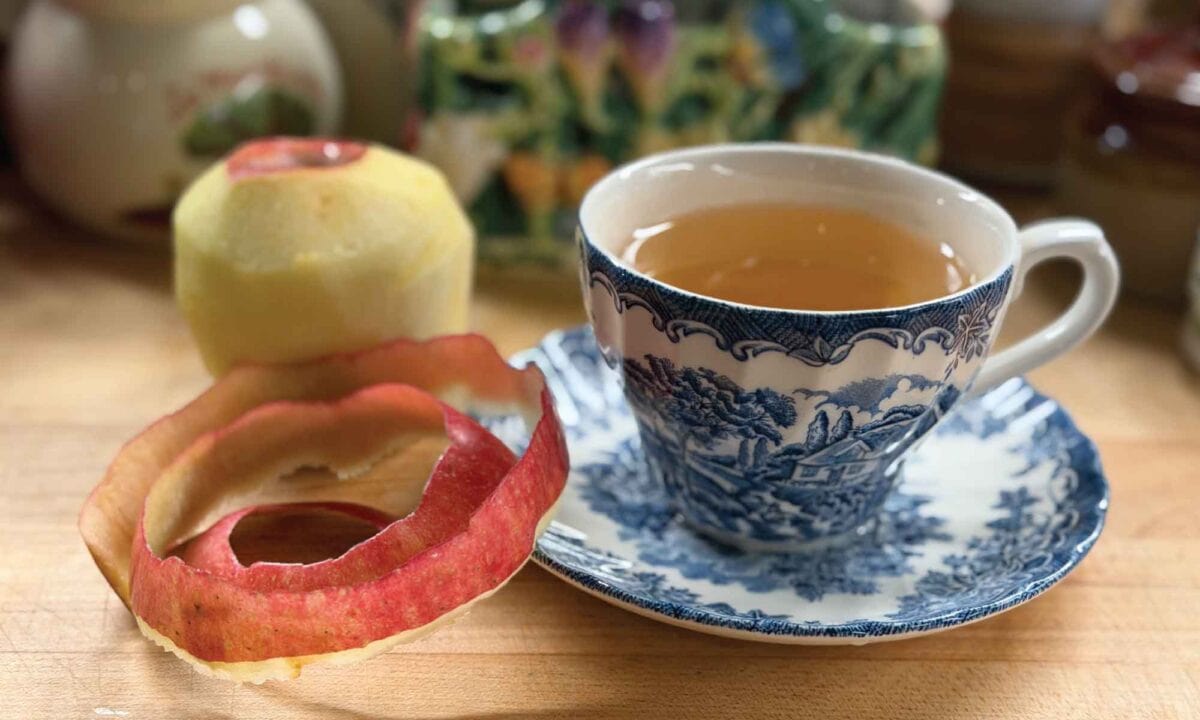
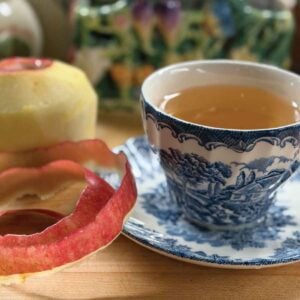
Apple Peel Tea is a light, old-fashioned drink made by gently simmering fresh or dried apple peels in water. It is not a strong tea in the way that black tea or herbal tea can be. Instead, it has a delicate apple flavor and a naturally pleasant aroma.
You can enjoy it plain or add traditional flavorings such as:
- A small cinnamon stick
- One or two whole cloves
- A thin strip of lemon peel
- A little honey
Apple Peel Tea is especially comforting on a cool evening or after a hearty meal. Best of all, it turns something that might otherwise be discarded into a warm and enjoyable drink.
Use Fresh or Dried Apple Peels
You can make Apple Peel Tea with either fresh or dried peels.
Fresh peels are perfect when you have just prepared apples for a pie, buckle, crisp, applesauce, or Apple Pandowdy. Simply set the peels aside and make your tea while your dessert bakes.
Drying the peels allows you to save them for later.
To dry apple peels, spread them in a single layer on a clean cloth, tray, or baking sheet. Allow them to air-dry completely, or place them in a very low oven at 200°F (93°C) or lower until they are crisp. (Note: You can find my recipe on How to Dry Apple Slices on page 256 of my bestselling book, The Modern Pioneer Cookbook.)
Once fully dried, store the peels in a clean glass jar or cloth bag in a cool, dry place. For the best flavor, use them within one year.
Whenever you plan to use the peels for tea, choose organic apples whenever possible because the peel is the part of the fruit most exposed to agricultural sprays.
Make Apple Pandowdy and Save the Peels
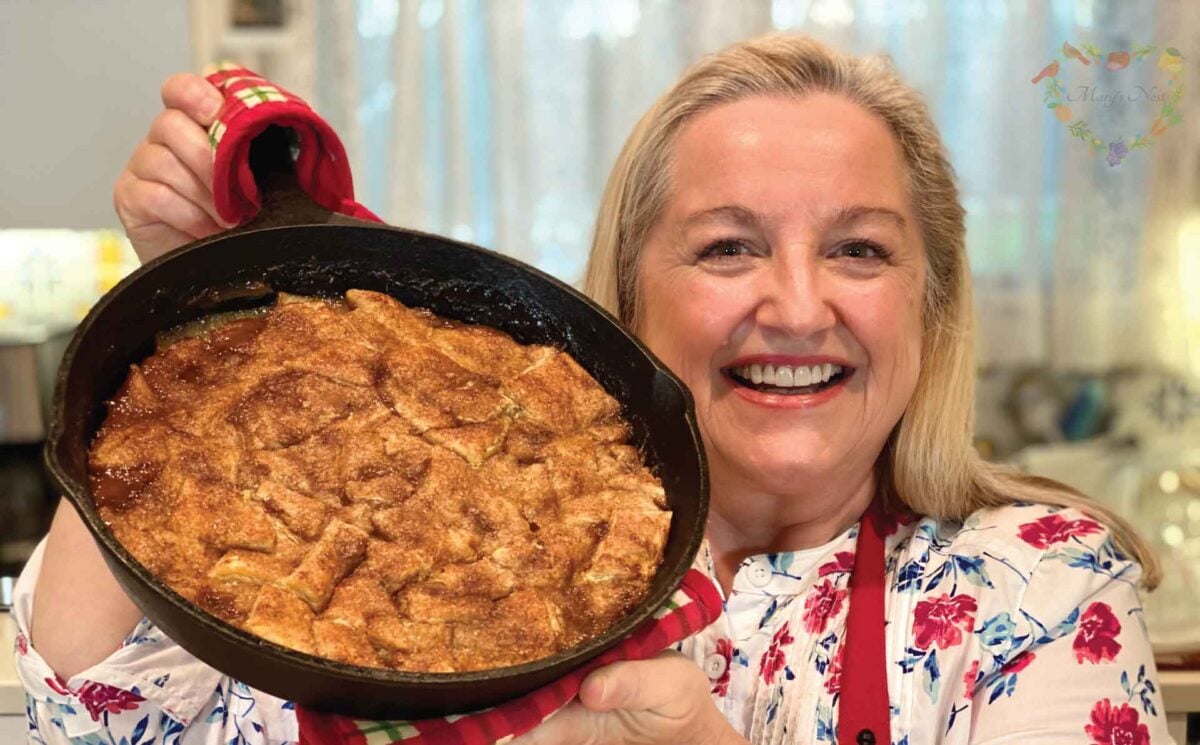
One of the best ways to gather enough peels for Apple Peel Tea is to make a traditional Apple Pandowdy.
Pandowdy dates back to early Colonial America, when settlers had to adapt Old World cooking traditions to New World ingredients. Apples were plentiful, especially in New England, where apple trees thrived and quickly became a cornerstone of the household pantry.
Colonial cooks were practical people. Flour was precious. Butter was churned by hand. Nothing was wasted. So instead of elaborate pies that required careful pastry work and lots of ingredients, home cooks developed desserts that were simpler and sturdier.
A Pandowdy is essentially a baked fruit dessert topped with a rough pastry dough that’s intentionally “dowdied”—broken and pushed down into the bubbling fruit as it bakes. The name itself reflects that humble nature. This recipe was never meant to be pretty. It was meant to be filling, warm, and comforting. And it succeeded at all three!
Using Apples as Your Dessert Fruit
When you make your Apple Pandowdy, place the apple peels to one side instead of discarding them. By the time dessert is baking in the oven, you can have a saucepan of Apple Peel Tea gently simmering on the stove.
Note: There are alternative ways to make pandowdy desserts. For example, you can find my recipe for making a Maple Sugar Apple Pandowdy on page 268 of my bestselling book, The Modern Pioneer Cookbook.
Abigail Adams and the White House Table

What makes Apple Pandowdy especially fitting for a patriotic summer meal is its connection to Abigail Adams, wife of President John Adams, and one of the most influential First Ladies in American history.
Abigail Adams was known for her intelligence, frugality, and practicality—qualities that showed up not only in her letters and political counsel to her husband, but also in the food served in her household. As a child growing up, my wonderful mother, Gloria, taught me American history often through the eyes and the kitchens of amazing women like Abigail Adams, who became one of my favorite women to study.
Simplicity in the Adams White House
Despite living in a time of great political change and social formality, Abigail favored simple, wholesome foods. She believed in moderation, economy, and nourishing meals prepared at home. Apple desserts—especially those that made good use of an abundant fruit prepared simply—were among her favorites.
Historical accounts note that apple pandowdies and similar baked apple dishes were served even at White House dinners during the Adams’ presidency. That may surprise modern readers who imagine early presidential tables as lavish affairs. But in truth, the Adams’ White House was known for restraint and simplicity. And that’s part of what makes this dessert so compelling.
A Dessert Shared by a New Nation
The same dish that could be served at the President’s table was also baked in modest hearth kitchens across New England. It belonged to everyone, and patriotism ran high in those days, with home cooks delighting in the knowledge that they had a little bit of White House fare on their own tables.
Or better yet, home cooks felt a camaraderie with Mrs. Adams, in that she was the one who had a bit of their home cooking on her White House table! These were proud American ladies who believed they contributed to building this new nation with simple home-cooked food that kept everyone well fed. And they did indeed!
Cool Off with Traditional American Switchel
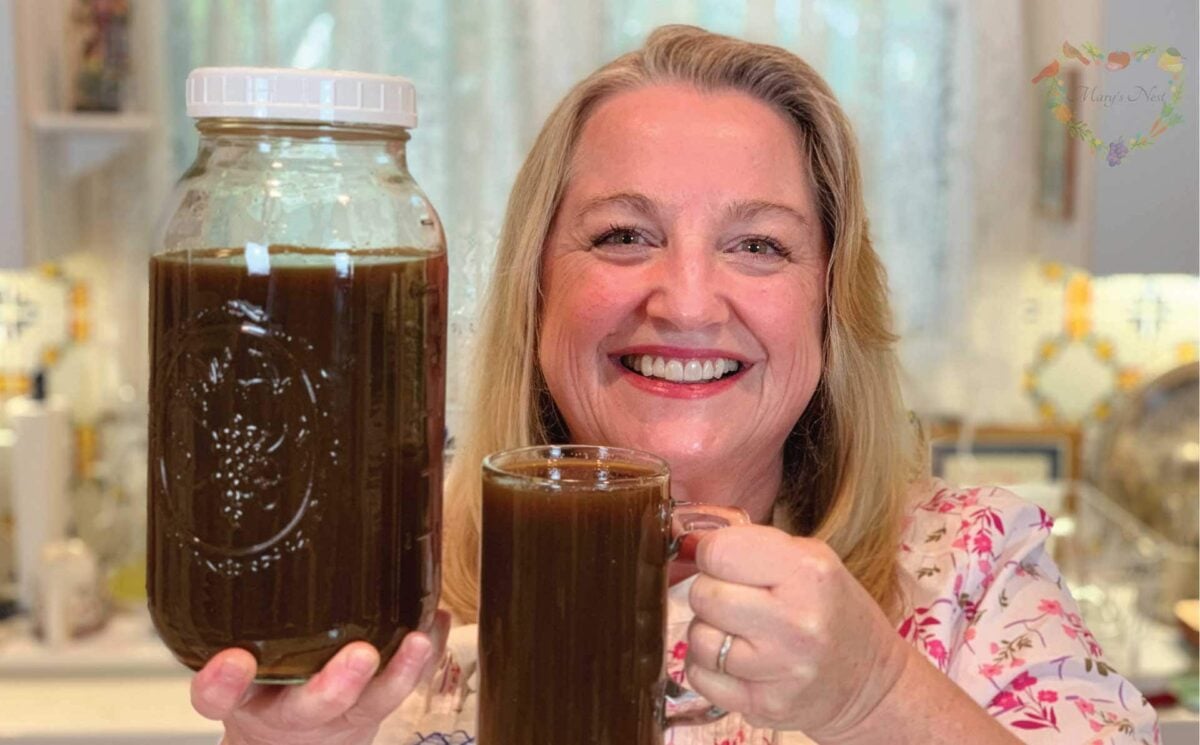
Apple Peel Tea is perfect when you want something warm and soothing, but early American home cooks also had a practical drink for hot summer days—Switchel.
Sometimes called Haymaker’s Punch, Switchel was traditionally made with water, apple cider vinegar, ginger, and a small amount of sweetener such as molasses, honey, or sorghum syrup.
It became especially associated with farmers and laborers working long hours in the summer heat, since switchel could be mixed in a jug and carried into the fields, where it provided a refreshing alternative to plain water. It has a lightly sweet, pleasantly tart, and gently spiced flavor with ginger.
Customize Your Switchel Ingredients
Like Apple Peel Tea and Apple Pandowdy, Switchel reflects the resourcefulness of traditional American home cooking. It relies on simple pantry staples and can be adjusted according to what a household has on hand.
Some families made it more tart, while others added more sweetener. Home cooks could use fresh ginger when available, and dried or ground ginger worked too.
Note: There are alternative ways to make Switchel beverages. For example, you can find my recipe for making a Pioneer Haymaker’s Switchel Punch on page 214 of my bestselling book, The Modern Pioneer Cookbook.
Three Recipes Built on Thrift and Simplicity
Apple Peel Tea, Apple Pandowdy, and Switchel may seem like three very different recipes, but they share the same values. Each one reflects:
- Thrift
- Resourcefulness
- Simplicity
- Seasonal eating
- Practical nourishment
- Gratitude for what we have
A Tricorn of American Recipes
Early American colonists typically wore a three-cornered hat called a tricorn. You can create a traditional American tricorn of recipes to capture the three simple tastes of the ingenuity that shaped our early traditional foods kitchens:
- Apple Pandowdy turns plentiful fruit and basic baking ingredients into a warm family dessert.
- Apple Peel Tea transforms scraps into a comforting drink.
- Switchel combines pantry staples into a refreshing beverage for a hot day.
More Thrifty Kitchen Videos
- Kitchen Life: Thrifty Kitchen Tips for a No Waste Kitchen
- How to Run a Thrifty Kitchen with Free Checklist
- 5 Best Thrifty Cooking Habits for Your Kitchen Today

- How to Run a Thrifty Kitchen (with a Free Checklist Download)

Keeping American Food Traditions Alive
When we prepare old-fashioned recipes, we are doing more than simply making something to eat or drink. We are learning how earlier generations lived, worked, and cared for their families. We are discovering the practical skills that helped households remain resilient and self-reliant. And we are passing that knowledge on to our children and grandchildren.
Most of these recipes were never considered fancy. They were simply part of everyday life. But that is exactly what makes them so valuable.
They remind us that some of the most enduring traditions are built from small acts: saving apple peels, baking a rustic dessert, mixing a simple drink, and gathering around the family table.
I hope you enjoy making this Old-Fashioned Apple Peel Tea and exploring the Apple Pandowdy and Switchel recipes too. Together, they offer a delicious way to celebrate American food history while bringing a little traditional wisdom into our modern kitchens.
Celebrating America’s 250th Anniversary
To celebrate America’s 250th Anniversary, I have something very special for you that I’m delighted to share with all of my Sweet Friends in today’s video: The Modern Pioneer Celebrates America Curriculum!
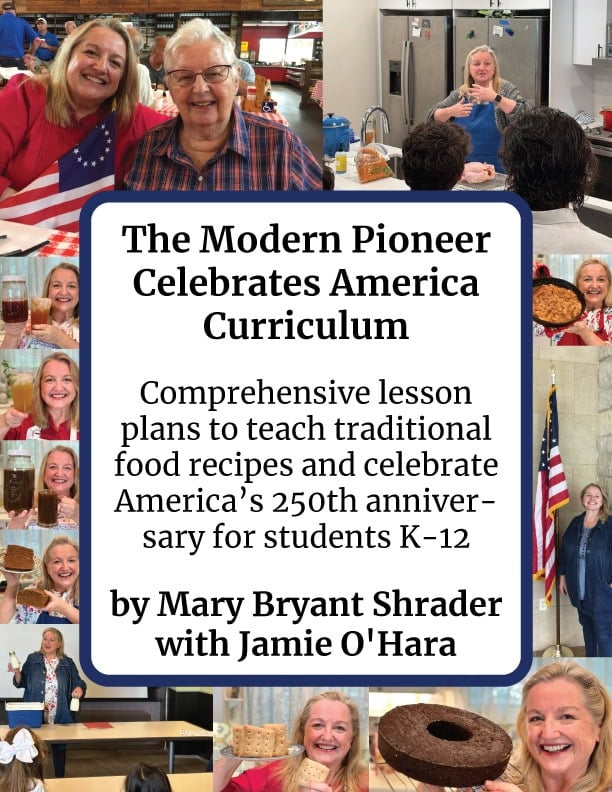
The Modern Pioneer Celebrates America Curriculum provides comprehensive lesson plans to teach traditional food recipes and celebrate America’s 250th Anniversary with students in grades K–12. This free curriculum brings together American history, civics, geography, literature, kitchen math, and hands-on cooking activities.
Through traditional recipes and meaningful lessons, students will step back in time and learn how home cooks helped nourish families through the founding of our nation, westward expansion, wartime sacrifice, the Great Depression, and more.
More Independence Day Posts and Recipes

Free K–12 American History Curriculum With Traditional Recipes
Celebrate America’s 250th with free K–12 American History lessons, recipes, and hands-on activities through traditional American foods.

The Maslin Method: A Blueberry Buckle—The Quintessential 19th-Century American Dessert
Bake a 19th-century blueberry buckle with The Maslin Method, blending whole grains for a tender, rustic summer dessert.

A Shrub, a Switchel, and a Shilling – Stories from a New England Tavern
Learn how to make Colonial American and British recipes and about my experience with America’s Bicentennial celebrations in 1976.
Grand Teton Ancient Grains

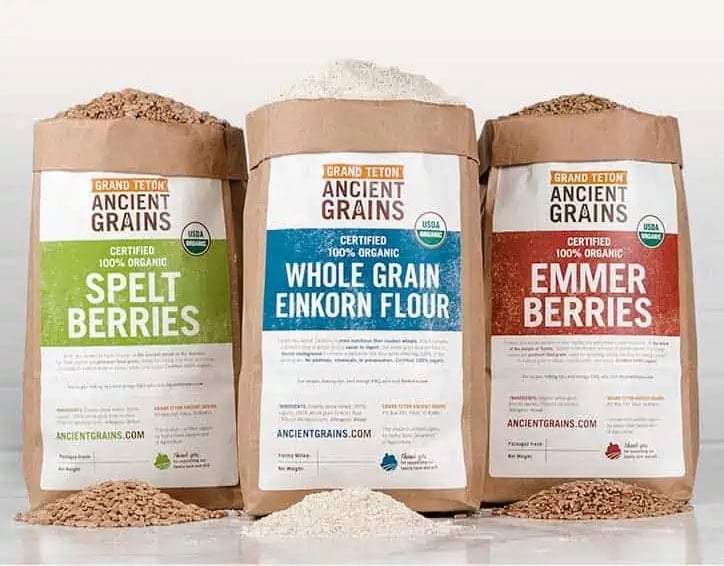
Check out the organic berries and flours available from Grand Teton Ancient Grains. I love their high-quality Einkorn, Emmer, Spelt, Millet, and more you can get to create nutritious and delicious baked goods.
Exclusive Newsletter Discount Code
Sign up for my free Mary’s Nest newsletter for an exclusive discount code you can use on your order of berries and flours. This discount is available for a limited time, so be sure to stock up on the Ancient Grains you would enjoy using to bake delightful breads, desserts, and more.
And if you’re looking for a grain mill to make fresh flour from your wheat berries, I recommend the Mockmill electric grain grinder. (See below.)
Grind Your Own Flour with the Mockmill
When it comes to electric grain mills, after I did A LOT of research, I decided to buy a Mockmill. And am I so happy I did! The Mockmill is a very affordable but beautifully crafted German-made mill that stone grinds grain with settings ranging from 1 to 10—fine to coarse ground grain.
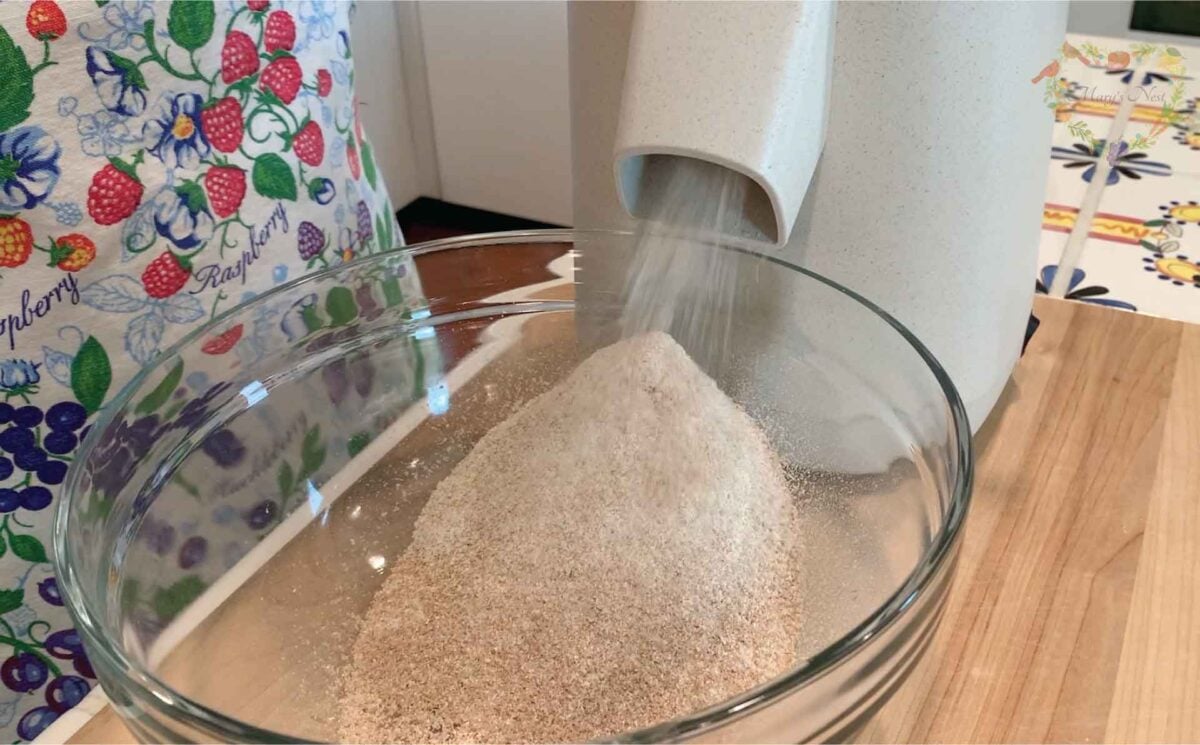
Learn more about Mockmill electric grain mills for making fresh flour and their Flake Lover’s Flaker that flakes whole grain in minutes. (This is not a sponsored post. I bought the Mockmill products that I show you, and I’m a happy user of their devices in my kitchen.)
- Get the Mockmill 100 Stone Grain Mill (Same product I show you in my unboxing video.)
- Mockmill 100 Grain Mill unboxing
- Flake Lover’s Flaker from Mockmill in action (Using this device, you can flake whole grain in minutes.)

Order YOUR COPY Now!
The Modern Pioneer Cookbook
Seasonal ingredients, traditional techniques, and nourishing recipes. Over 85 traditional, from-scratch recipes! Discover for yourself how you can use simple ingredients and traditional techniques to cook the modern pioneer way.

Order YOUR COPY Now!
The Modern Pioneer Pantry
Simple ingredients, timeless techniques, and a well-stocked pantry. Discover over 100 nourishing recipes to preserve food and turn pantry staples into homemade meals. Build a wholesome, traditional pantry—just like a modern pioneer!
Start Your Traditional Foods Journey
Sharing my passion for traditional cooking goes beyond my YouTube cooking school—it also comes to life in the pages of my cookbooks. Both of my books, The Modern Pioneer Cookbook and The Modern Pioneer Pantry, are proudly published by Penguin Random House.
The first is filled with time-honored recipes to help you create a traditional foods kitchen, while the second is your complete guide to home food preservation. Order both books today to start or continue your traditional foods journey.
Download Your Free 36-Page Pantry List
For an extensive list of the traditional foods you can make and purchase to stock your pantry, be sure to download my free 36-page Traditional Foods Pantry List. This comprehensive eBook is full of links to recipe videos, helpful articles, and more!

Join the Traditional Foods Kitchen Academy
Are you looking for more traditional foods videos? If so, I invite you to join the Traditional Foods Kitchen Academy. Members of this optional paid YouTube community get access to exclusive videos and other members-only perks. Plus, your YouTube comments include a special members-only badge.
Kitchen Academy Videos
How Much of Each Natural Remedy Should You Make?
Use your family’s needs, past experience, and seasonal habits to decide how much to prepare for your Healing Pantry.

Baking Questions Answered with Ted and Mary!
Join me and my husband Ted for a Q&A filled with practical kitchen tips, helpful techniques, and answers to your baking questions.
Baking with Whole Grains: The Maslin Method, Grain Mills, and America’s Bread Basket
Explore whole grain baking with The Maslin Method, fresh-milled flour, grain mills, heritage wheats, and more.
Stay in Touch with Mary’s Nest
- Subscribe to My YouTube Channel for Traditional Foods Videos (Free) - When you subscribe, be sure to click on the notification bell that will let you know each time I upload a new video.
- Subscribe to Mary’s Traditional Foods Newsletter (Free) - Get a free 36-page eBook for signing up: How to Stock Your Essential Traditional Foods Four-Corners Pantry.
- Join the Traditional Foods Kitchen Academy - For more detailed videos and exclusive members-only perks, join my YouTube membership community.
- Order The Modern Pioneer Cookbook - Get a hardcover book of Mary's nourishing recipes from a Traditional Foods Kitchen. This bestselling cookbook is published by Penguin Random House with their DK imprint.
- Order The Modern Pioneer Pantry - Get Mary's latest hardcover cookbook about preserving food and making delicious meals from your Four Corners Pantry. Mary's second cookbook is also published by Penguin Random House.
I look forward to having you join me in my Texas Hill Country Kitchen!
I’d like to receive more tips and recipes from Mary’s Nest.
Traditional Apple Peel Tea
Equipment
- 1 Vegetable peeler or paring knife
- 1 Small saucepan
- 1 Teacup or mug
- 1 Clean cloth, tray, or baking sheet if drying the peels
Ingredients
- Peels from organic apples, fresh or dried
- Water to cover the peels
- 1 small cinnamon stick Optional
- 1-2 whole cloves Optional
- 1 thin strip of lemon peel Optional
- Honey Optional, to taste
Instructions
- Peel your organic apples, or save the peels left over from another apple recipe.
- To use the peels fresh, proceed directly to making the tea.
- To dry the peels, spread them in a single layer on a clean cloth, tray, or baking sheet. Allow them to air-dry completely, or dry them gently in an oven set to 200°F (93°C) or lower until crisp.
- Place a small handful of fresh or dried apple peels into a small saucepan. Use slightly more peels when fresh and slightly fewer when dried.
- Add the cinnamon, cloves, or lemon peel, if using.
- Pour in enough water to cover the apple peels.
- Bring the water just to a gentle simmer.
- Reduce the heat to its lowest setting and allow the peels to simmer softly for 5–10 minutes.
- Strain the tea into a cup.
- Sweeten lightly with honey, if desired, and enjoy warm.
Notes
- Apple Peel Tea is traditionally light and mild rather than strong or concentrated.
- Adjust the amount of apple peels to suit your taste.
- Dried apple peels can be stored in a clean glass jar or cloth bag.
- Always make sure dried peels are completely free of moisture before storing them.
- A cinnamon stick or a few whole cloves can add warmth without overpowering the delicate apple flavor.
- This tea is best enjoyed occasionally as a simple seasonal treat.
- Recipes to use the whole apple (except for the seeds): Peel the apples and save the apple peels to make Apple Peel Tea. Slice the peeled apples to make an Apple Pandowdy dessert recipe.
Shop for My Favorite Items
Favorite Kitchen Supplies
- Favorite Aprons
- Spice Grinder
- Countertop Burner (On my kitchen island in many recipe videos.)
- Handheld Vacuum Sealing System
- Vacuum Lids
- Whisk
- Silica Gel Packets (Helps keep moisture from building up in your mix)
- Cast Iron Dutch Oven
- 8-Quart Slow-Cooker
- Fat Separator (Clever kitchen device to help you decant bone broth)
- Flour Sack Towels
- pH Strips (Helps you check on the acidity of your vinegar)
Amazon Shop and Shopping Guide
- Visit Mary’s Nest Amazon Shop
- Get a 30-day Audible trial with a free audiobook
- Visit my Shopping Guide page
Get up to 15% off for stocking your Traditional Foods Pantry and equipping your Modern Pioneer Kitchen, including discounts from US Wellness Meats, Farmhouse Teas, Backwoods Home, Masontops, Cultures for Health, Survival Garden Seeds, Redmond Real Salt, and More!